
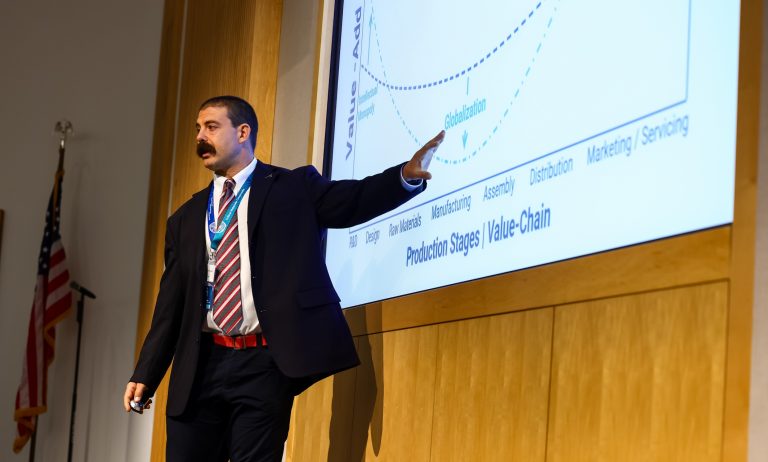
More than 200 leaders from businesses, economic development organizations, government agencies, nonprofits and universities gathered at the Kauffman Foundation in Kansas City to advance a shared vision: building the nation’s next great innovation ecosystem through the Critical Materials Crossroads.
The Critical Materials Crossroads, spearheaded by the University of Missouri-Kansas City, is an emerging regional movement focused on securing America’s supply of the critical materials that power modern life — from batteries and artificial intelligence systems to aerospace technology, medical devices and clean-energy infrastructure.
While the idea began at UMKC, the initiative has grown into a coalition of more than 150 partners across Missouri and Kansas. Industry, higher education, government, workforce development and community organizations are now aligned behind a single goal: to make the heartland of the United States into a national hub for critical materials discovery, processing, advanced manufacturing and workforce training.
A Nationally Recognized Vision

UMKC Chancellor Mauli Agrawal stands next to Anthony Caruso, vice chancellor for strategic initiatives and the leader of Critical Materials Crossroads.
The proposal for the Critical Materials Crossroads has already earned national attention. In 2025, the National Science Foundation selected the initiative as one of just 15 finalists — out of 285 proposals — for its Regional Innovation Engines program. The NSF will visit Kansas City in January 2026 for an on-site evaluation, and winners will be announced later in the year. Awardees may receive up to $160 million over 10 years, which would make it the largest grant in UMKC history if Critical Materials Crossroads is selected.
For Chancellor Mauli Agrawal, the NSF recognition reflects the region’s collective strength. Agrawal urged stakeholders at the meeting to think of the Critical Materials Crossroads as “a living ecosystem.”
“When universities, industry, government and communities unite,” Agrawal said, “America can once again lead the world in innovation and manufacturing, starting right here in the heartland.”
Why Critical Materials Matter
Critical materials — including rare earth elements, lithium, cobalt and specialty metals — are essential to the technologies that drive the modern economy. Yet the United States currently relies on foreign countries for roughly 90% of its refined supply, much of it from geopolitical competitors.
This reliance creates significant economic and national security risks.
“Decades of offshoring have weakened our industrial base,” said Anthony Caruso, UMKC vice chancellor for strategic initiatives and the project’s principal investigator. “If we cannot produce or process the materials that power our technologies, we are vulnerable.”
The goal of the Critical Material Crossroads is to reduce the supply chain risk by building a resilient, domestic supply chain anchored in the Midwest. The collaborative effort is bi-partisan.
“For too long, we’ve allowed our dependence on foreign supply chains to grow into a strategic vulnerability,” said Missouri Senator Eric Schmitt, whose staff attended the conference. “It’s time to rebuild America’s industrial base and reclaim our leadership in the global minerals race. The Trump Administration and I are working hand-in-hand to lead a new golden age of American resource independence, reducing our reliance on foreign countries, particularly China, and revitalizing our critical materials ecosystem. I am proud to support key efforts like those of UMKC that will bring critical minerals processing not only to the U.S. but Missouri specifically.”
A Blueprint for Transformation

Hiroko Kawai, senior director of Panasonic Energy Corporation of North America, spoke at the Critical Materials Crossroads conference.
If fully funded and built, the Critical Materials Crossroads would establish an integrated research-to-manufacturing ecosystem across hundreds of acres in the Kansas City region. The vision includes:
- State-of-the-art research laboratories
- Pilot- and demonstration-scale processing and manufacturing facilities
- Training centers supporting degree, certificate and apprenticeship pathways
- Startup incubators and small-business development hubs
- A workforce pipeline designed in partnership with regional employers
The projected economic impact is substantial. By 2036, the initiative could create more than 3,000 direct jobs and an additional 6,000 indirect jobs yielding $40 billion in gross regional output and adding $17 billion to the regional gross domestic product.
One of the speakers at the conference was Hiroko Kawai, senior director of Panasonic Energy Corporation of North America, which opened an electric vehicle battery facility earlier this year in De Soto, Kansas, in the Kansas City metropolitan area.
“The Critical Materials Crossroads gathered people and companies to highlight our attention to this region and to this issue, not in a high-level and abstract way, but in a tangible, concrete effort for Kansas and Missouri,” Kawai said. “It is real, and therefore, really meaningful.”
A Regional Movement Built on Collaboration

Maria Meyers, UMKC vice chancellor of commercialization and entrepreneurship, spoke at the Critical Materials Crossroads conference.
Throughout the stakeholder conference, speakers emphasized that the Critical Materials Crossroads has the ingredients for success because it is being built from the ground up through shared trust, community leadership and broad regional participation. The afternoon included breakout session workshops on industry and commercialization, research and development innovation and workforce innovation.
Partners include:
- Research universities across Kansas and Missouri
- Advanced manufacturers and technology companies from Oregon to Australia
- Local and state governments
- Workforce partners such as the Full Employment Council, Great Jobs KC, Enterprise KC, the Missouri Community College Association and the Missouri’s State Workforce Development Board
- Investors and capital partners positioning the region for commercialization and scale
Agrawal noted each sector plays an essential role:
“Individually, every one of the stakeholder groups is essential,” he said. “Combined, they are transformative.”
Talent at the Center
Critical Materials Crossroads is equally focused on people — developing a workforce that can support the next generation of advanced manufacturing.
Pathways will include roles in:
- Materials science and engineering
- Industrial and chemical engineering
- Automation and AI-enabled manufacturing
- Supply-chain logistics
- Entrepreneurial ventures supporting a new industrial cluster
- Legal, finance, business strategy, history and environmental sciences
The initiative is expected to create opportunities across a wide range of skill levels, from high-school graduates to post-doctoral researchers.
The Kansas City area’s geography, infrastructure, research strength and manufacturing heritage make it uniquely positioned to lead America’s next industrial era. The region sits at the literal and symbolic crossroads of the nation where transportation networks, talent pipelines and technological innovation converge.
Critical Materials Crossroads’ leaders believe this moment is decisive.
“The Greater Kansas City area will not just participate in America’s critical materials future,” Agrawal said. “We will define it.”